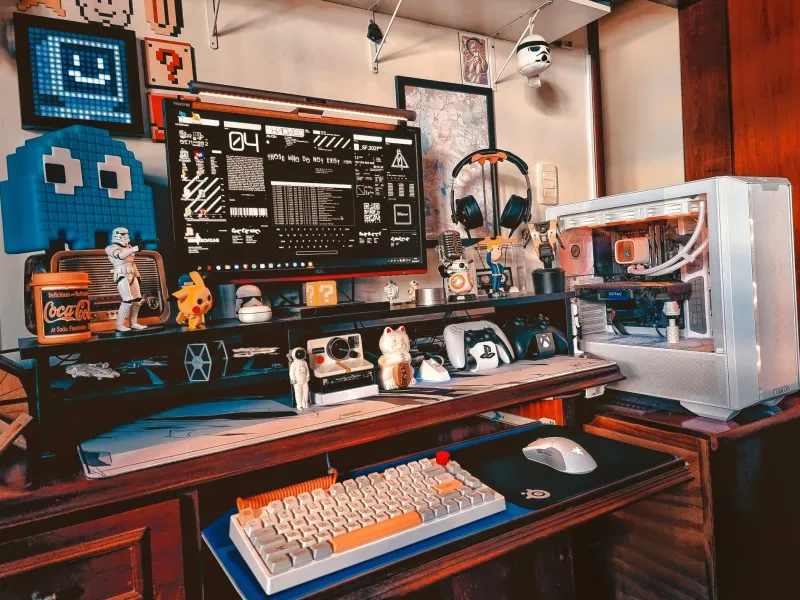
The Ghost in the Memory Card: What Save Points Say About Our Fear of Getting Things Wrong

Photo by Photo by Hector Argüello Canals on Unsplash on Unsplash
Let me paint a picture that will hit different depending on your gaming generation.
It's 1986. You've spent four hours on The Legend of Zelda, mapping dungeons on graph paper, scraping together rupees, and finally — finally — making real progress. Then your little brother trips over the power cord. Gone. All of it. You start over, or you don't play at all.
Now fast-forward a decade. Final Fantasy VII ships with a memory card slot and dedicated save points. Suddenly, the rules of consequence have changed. Death is temporary. Bad decisions are reversible. The game world persists — and so does your place in it.
That shift wasn't just a quality-of-life improvement. It was a philosophical rupture.
Before the Safety Net
Early gaming was genuinely unforgiving in a way that modern players find almost shocking. Games like Ghosts 'n Goblins, Battletoads, or the original Ninja Gaiden operated on a simple moral economy: you pay attention, or you pay with everything. There were no checkpoints softening the blow. Failure meant returning to the very beginning, carrying nothing but the knowledge of what went wrong.
This sounds brutal, and it was. But it also produced a specific kind of relationship between the player and the game. Every run was real in a way that mattered. The stakes were genuine because the consequences were permanent. Philosopher Bernard Williams wrote about the concept of "moral residue" — the idea that even when we make the right choice, something is lost or marked by the difficulty of the decision. Early games, unintentionally, built moral residue right into their structure. Every death left a scar on your afternoon.
There was also, paradoxically, a kind of freedom in that harshness. When you can't save and reload, you stop agonizing over every micro-decision. You commit. You adapt. You develop what might genuinely be called resilience, even if it mostly felt like rage at the time.
The Save Point Revolution
When save mechanics arrived in earnest — through battery-backed cartridges, memory cards, and eventually cloud saves — they democratized gaming in an important way. Longer, more complex stories became accessible to people who couldn't dedicate eight uninterrupted hours to a single session. RPGs bloomed. Narrative games found their audience. The medium grew up.
But something else happened too, something subtler and worth sitting with.
The save point introduced counterfactual thinking as a core gameplay mechanic. Suddenly you weren't just playing the game — you were playing versions of the game, testing branches, reloading when outcomes didn't match expectations. The "real" playthrough became a kind of curated highlight reel of your best decisions, with all the embarrassing failures quietly overwritten.
Sound familiar? It should. That's also a pretty accurate description of how a lot of us manage our digital identities.
The Psychology of the Reload
Here's where things get genuinely interesting from a psychological standpoint. Research in behavioral science suggests that the option to undo a decision actually changes how we make decisions in the first place. When we know we can go back, we take the choice less seriously. We experiment more freely — which can be a good thing — but we also invest less emotionally in outcomes, which can make us worse at learning from failure.
In gaming terms: players who save-scum their way through a hard fight don't build the same skill set as players who have to adapt and survive. The knowledge that you can reload creates a quiet permission to be reckless, because recklessness is consequence-free.
This maps uncomfortably well onto certain corners of modern life. The ability to delete a text, edit a tweet, or rebrand your entire online persona after a public mistake has created a cultural expectation that failure is something to be managed rather than metabolized. We've outsourced the uncomfortable work of sitting with consequences to the undo button.
Redemption Isn't the Same as Reversal
Here's the philosophical wrinkle that retro gaming mechanics accidentally illuminate: there's a meaningful difference between redemption and reversal.
Redemption requires that something actually happened. It requires acknowledging the failure, carrying it forward, and doing something different because of it. It's the story arc of every compelling RPG protagonist — the hero who fails, learns, and comes back changed.
Reversal just... erases. Load the save file. Try again. No scar tissue, no growth, no story.
Games that understood this distinction produced some of the most emotionally resonant experiences in the medium. EarthBound and early Fire Emblem titles are good examples — games where the death of a character was permanent, where you couldn't just reload and replay the battle until everyone survived. Those losses meant something because they couldn't be undone. Players who lost a beloved character in Fire Emblem didn't forget it. They built their entire strategy around honoring that loss going forward.
That's redemption logic. It acknowledges failure as real and asks what you do next, not how quickly you can pretend it didn't happen.
What We Actually Want From Do-Overs
The desire for a save point isn't really about laziness or avoidance — at its core, it's about something deeply human. We want the chance to be better than we were. We want the story to come out right. We want, on some level, to be the version of ourselves who makes the good call under pressure.
The question is whether the reload actually gets us there, or whether it just lets us perform that version of ourselves without doing the work.
The most honest games — and maybe the most honest lives — find a middle path. They allow for failure without making it catastrophic. They build in checkpoints without erasing consequences entirely. They let you try again while still making it count that you failed in the first place.
The memory card didn't corrupt our relationship with failure. But it did give us a new question to answer every time things go sideways: are you going to reload, or are you going to play through?
Sometimes the bravest thing in any game — or anywhere else — is leaving the save file where it is.