Three Channels and a Feeling: How Square Waves Said What Orchestras Couldn't
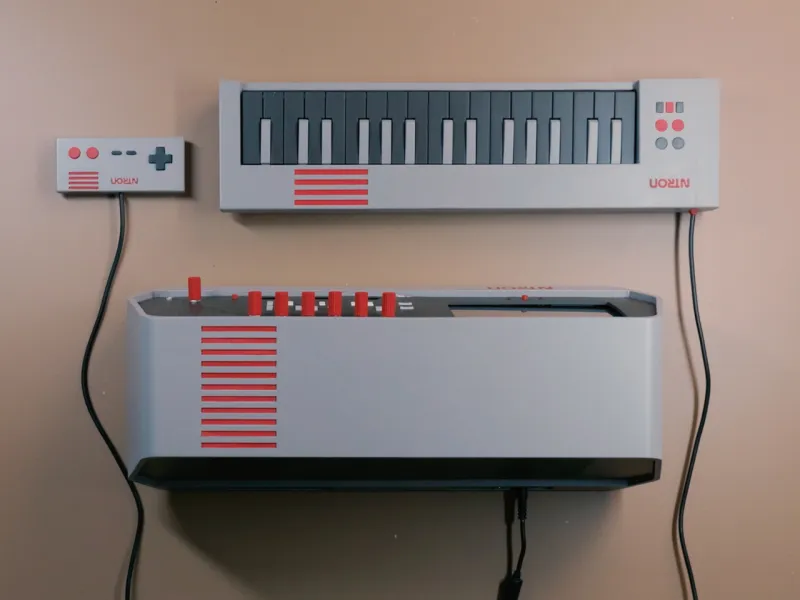
Photo: chiptune synthesizer retro video game music production keyboard, via www.yankodesign.com
Think about what Koji Kondo was working with on the original Legend of Zelda score. Three melodic channels and a noise channel for percussion. No reverb to speak of. No vocals, no strings, no dynamics beyond what a waveform could scream. A high school band director has more instruments at their disposal.
And yet. Type the opening notes of the Zelda overworld theme into a room full of thirty-somethings and watch what happens to their faces.
Constraint as Composition
Orchestral scoring communicates emotion through texture — swells, timbres, a hundred musicians breathing together. Chiptune couldn't do that. So composers like Kondo and Nobuo Uematsu had to communicate through structure alone: melody, rhythm, and repetition stripped down to the bone.
What that produced was emotional clarity. When the Final Fantasy battle theme kicks in, there's no ambiguity about the feeling. The arpeggios are urgency. The bass line is a heartbeat under duress. Uematsu couldn't hide behind arrangement, so every note had to earn its slot in the sequence.
Compare that to the problem with a lot of modern scoring: when you can have anything, emotion gets muddy. When you can have almost nothing, emotion gets precise. The 8-bit composers were forced into a kind of musical haiku — seventeen syllables, no wasted breath.
Even the looping, born of memory limitations rather than aesthetics, did psychological work. A dungeon theme that cycles every thirty seconds becomes, over an hour of play, a kind of emotional weather. You stop hearing it and start feeling it — dread as ambience, tension as wallpaper. Modern game composers spend fortunes on adaptive scores trying to replicate what a two-bar loop accidentally achieved.
Why the Lo-Fi Kids Came Home
Now look at what's charting. Lo-fi beats to study to. Synthwave soundtracking every Netflix trailer. Chiptune festivals. Vaporwave built on the skeletons of '80s presets.
This isn't nostalgia alone — plenty of generations are nostalgic without rebuilding their entire musical aesthetic around it. Something else is happening. A generation reporting record levels of anxiety is gravitating toward music defined by predictability. Chiptune loops. Synthwave pulses. Nothing syncopates into chaos, nothing swells into overwhelm. The music is legible. It resolves. It does what it says.
There's a reasonable argument that minimalist electronic music functions like a weighted blanket for the nervous system. The square wave doesn't have subtext. In an era where every notification is ambiguous — is that text mad at me? — a sound that means exactly one thing is a kind of relief.
The Lesson in the Limitation
There's a broader point here about creativity under constraint. Kondo and Uematsu weren't great despite their limitations; they were great through them. The NES sound chip was a box, and the box forced decisions, and decisions are where art lives.
It's a lesson anyone making anything could stand to hear. Remove one tool. Impose one rule. Write the essay in fewer words, design the level with one mechanic, score the scene with three channels.
The orchestra can make you feel everything. The square wave makes you feel one thing, completely. Some days, that's the miracle.